
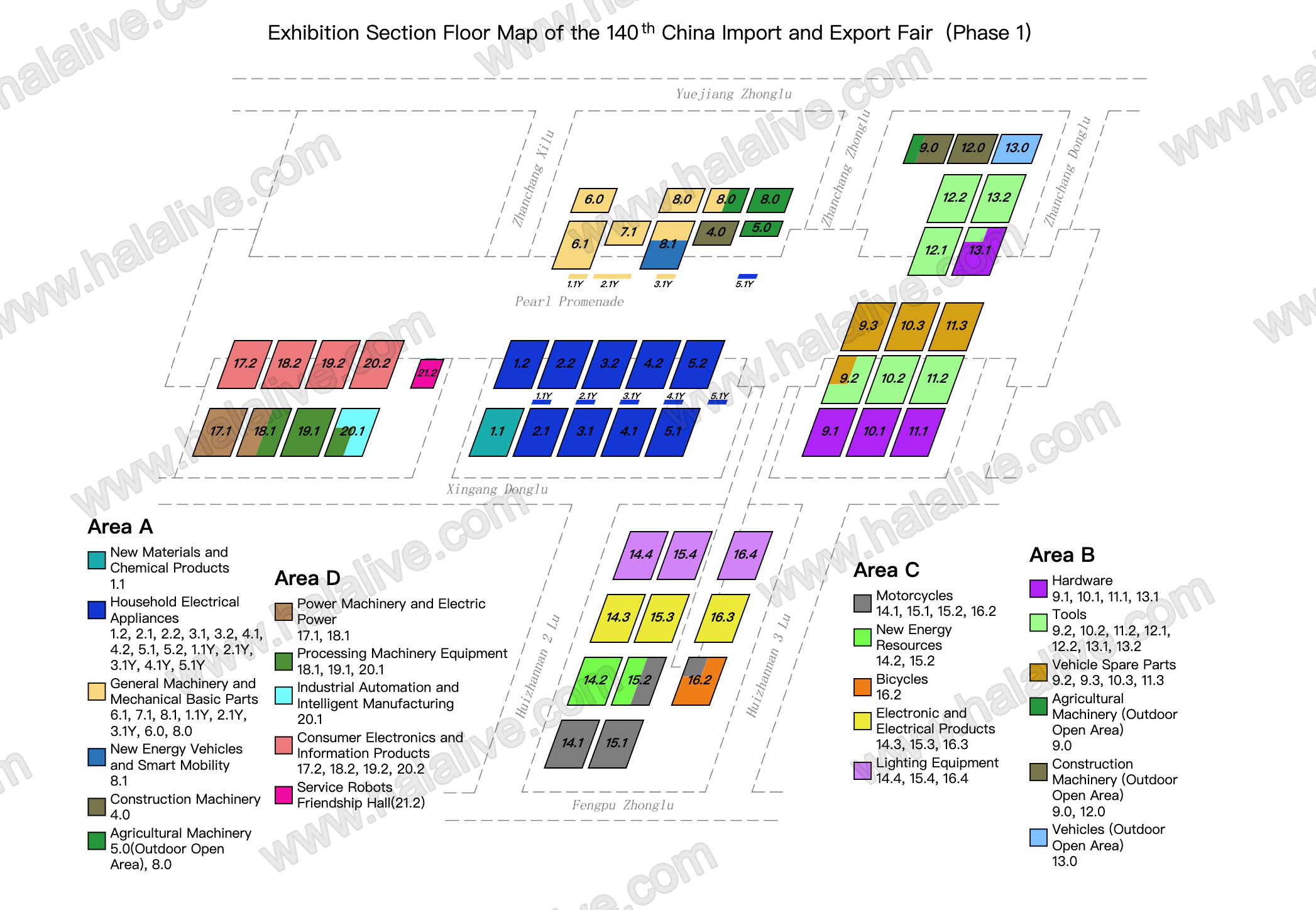
Key focus
Phase 1 is industrial & tech
Home appliances, machinery, new energy, electronics and lighting. Food and packaging sit in Phase 2 (23–27 Oct) and Phase 3 (31 Oct – 4 Nov).
Four zones, one campus
Zone A appliances & machinery · Zone D processing machinery & electronics · Zone C new energy & lighting · Zone B hardware & auto parts.
Food buyers: start with machinery
Processing machinery is in Zone D (18.1, 19.1, 20.1); food products are in Phase 2/3 — plan a return visit.
Opportunities
Purchasing agent on site
We source and buy halal food in China on your behalf and guide you through export — compare and order without a full-time China team.
Phase 1 at a glance: China's place in global exports
Phase 1 of the Canton Fair covers industrial and tech goods — home appliances, general machinery, new-energy vehicles, consumer electronics, lighting and new energy — the strongest slice of "Made in China" exports. China ships over US$100 billion of home appliances a year and leads the world in NEV and power-battery output; it accounts for roughly 80% of global lighting capacity. For an overseas buyer, Phase 1 is the most efficient single window into China's full industrial supply chain.
Global halal food trade: a certain multi-trillion-dollar opportunity
The global halal food market reached roughly US$2–2.5 trillion in 2025, with forecasts of US$3.3–3.7 trillion by 2030 — a 9–13% CAGR, well above overall food trade. The Middle East and Southeast Asia are the fastest-growing regions.
Saudi Arabia imported US$27.4 billion of food in 2023, the largest food importer in the OIC; GCC countries import roughly 85% of their food. For China-based suppliers, halal food exports to Muslim markets are a large, fast-growing and comparatively under-supplied lane.
Four regional plays: the Middle East, Southeast Asia, Europe, North Africa
Middle East
The six GCC states import roughly 85% of their food; Saudi Arabia is the OIC's largest food importer and the UAE (Dubai) is the re-export hub for the wider MENA. Halal certification is a hard requirement here, not an option — winning local recognition first (SFDA for Saudi, ESMA for the UAE) is the key to this market.
Southeast Asia
Indonesia has the world's largest Muslim population and made halal certification mandatory from October 2024 — import substitution drives steady demand for semi-finished inputs and processing machinery. Malaysia is the halal standards and re-export hub (JAKIM / HDC), ideal for certification backing and a regional distribution springboard.
Europe
France, Germany and the UK each hold several million Muslim consumers; halal food runs on private-label supermarket channels, and while certification follows EU rules, halal remains a niche lane. Central Europe (Poland / Czechia / Slovakia) is the EU processing and distribution base — a fit for EU-compliant local deep processing and warehousing.
North Africa
Egypt is the largest single Arab market (100m+ people) with a mature food-processing sector and heavy raw-material imports; Morocco, Algeria and Tunisia show steady halal demand growth — a low-cost springboard into Francophone and Arabic-speaking halal markets.
Governments are pushing "deep processing" — the sourcing logic is shifting
Buyers used to import finished goods; now major importers are pushing local deep processing over finished-good imports. Saudi Arabia targets localising 85% of its food industry under Vision 2030, launched the Jeddah Food Cluster (SAR5.3bn) in 2024 and set up the Halal Products Development Company (HPDC). The UAE's National Food Security Strategy 2051 commits AED30 billion to food processing and agritech.
Indonesia made halal certification mandatory for food from October 2024, pushing local processing. The shared result: markets no longer just "buy finished goods" — they want "imported raw/semi-finished inputs + local processing + own brands".
Hidden opportunities: three entry points most buyers miss
Semi-finished inputs
Since markets want local deep processing, the surest growth is not finished snacks but semi-finished ingredients — dried-fruit paste, cocoa powder, seasoning bases — lower barriers, higher re-orders, away from the finished-goods red ocean.
OEM / private label
Local brands lack capacity and will contract Chinese factories to produce under their own halal brand — higher margins.
Halal certification as a moat
Halal only commands value where certification is required — animal-derived or composite products — and certified suppliers are scarce. Winning reciprocal recognition (SFDA / BPJPH / JAKIM) early is a real barrier.
An action plan for buyers
First clarify your role: finished-goods distribution or local deep processing — the former picks finished goods, the latter prioritises semi-finished inputs. Second, treat halal recognition and documents as hard filters when vetting suppliers, not an afterthought.
Finally, use the Canton Fair window: in Phase 1, visit Zone D for processing machinery (18.1 / 19.1 / 20.1); in Phase 2 and 3, meet food-product and semi-finished factories — machinery to ingredients in one trip.